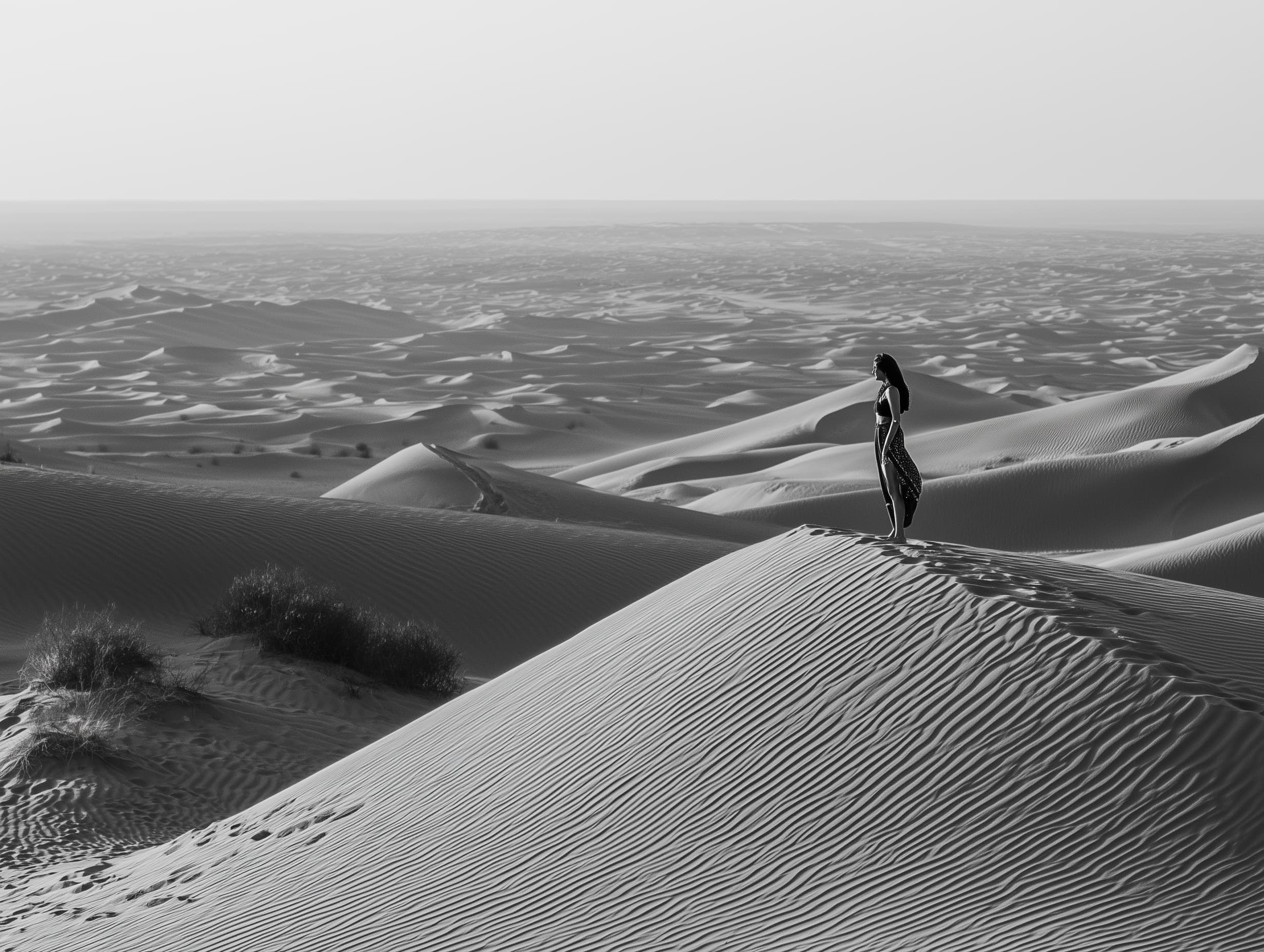
The desert is often described as empty. Endless space, minimal detail, nothing to focus on. While that may seem true at first glance, it hides a more complex reality. The truth is simple: emptiness is never truly empty — it changes how we see. In vast landscapes, perception shifts. Small details become meaningful. Silence becomes physical. Distance becomes emotional.
Distance and isolation in desert landscapes
The desert reshapes perception.
Distances feel longer. Time slows down. The absence of visual noise changes how attention settles.
There are no distractions.
Only space.
And that space becomes the subject.
Observing the unnoticed
Without clear focal points, the eye begins to search differently.
Small details take importance — a road cutting through the landscape, a distant structure, a shadow stretching across the ground.
These elements would normally go unnoticed.
Here, they define the image.
Atmosphere over subject
In these environments, the subject becomes secondary.
What matters is how the frame feels — the density of the air, the silence, the way light interacts with the ground.
These subtle elements create a sense of place that goes beyond the visual.
Movement within stillness
Even in stillness, there is movement.
Heat distorts the air. Light shifts. Shadows slowly extend.
These changes are constant, but never obvious.
They require patience.
Conclusion
The desert is not defined by what it shows.
It is defined by what it removes.
And in that absence, perception sharpens.
The image becomes less about capturing something — and more about understanding a space.

Noah Bennett
Documentary Photographer