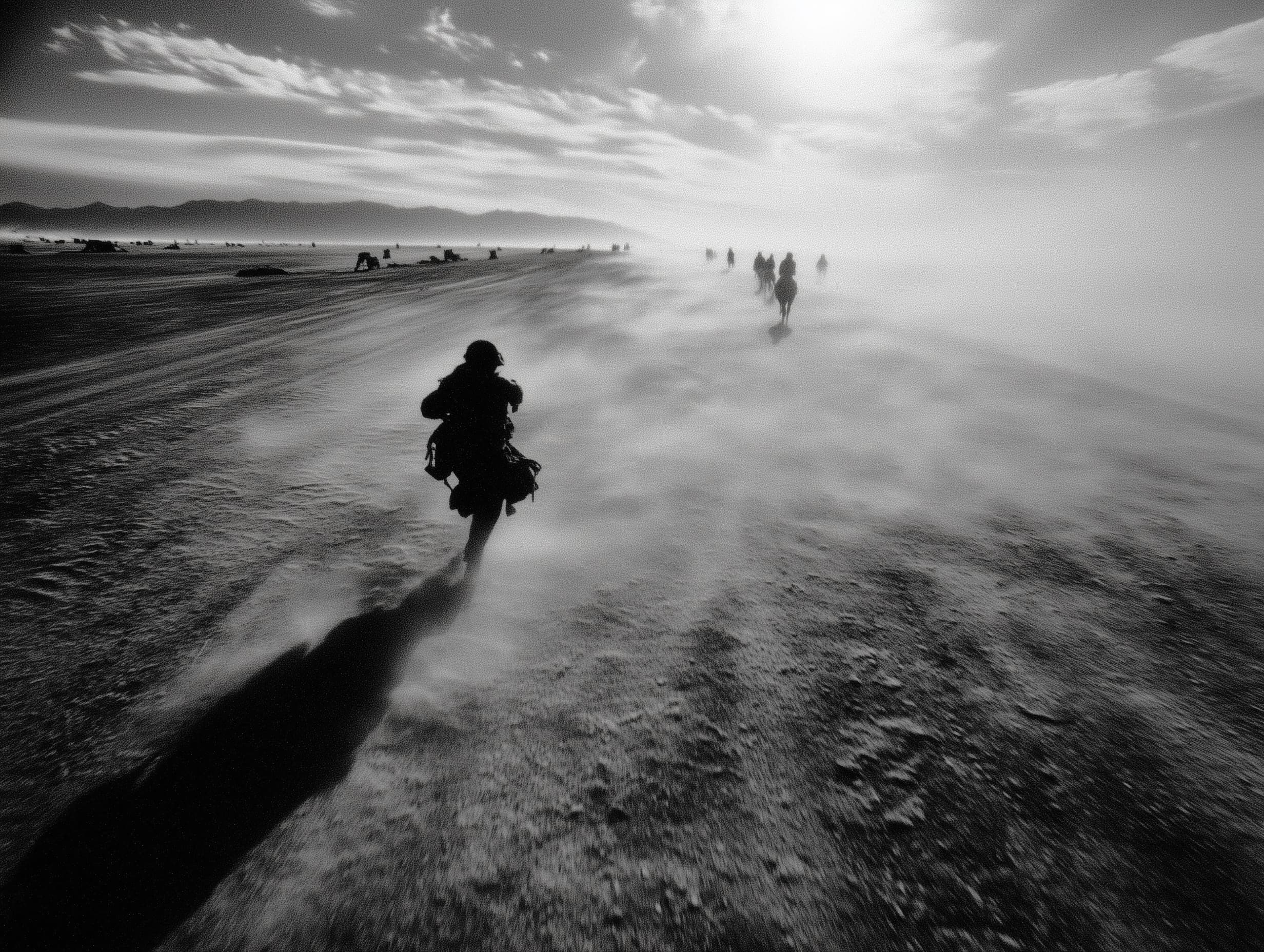
For years, photography has been defined by control. Sharp focus. Perfect timing. Clean composition. While these elements matter, they only capture part of the story. A technically perfect image can still feel lifeless, disconnected from reality. The truth is simple: people don’t remember precision — they remember presence. In environments shaped by movement, dust, and unpredictability, photography becomes something else entirely. It shifts from control to instinct, from perfection to atmosphere, from stillness to motion.
Dust and motion as a visual language
Photography is often about control — capturing a precise, frozen moment.
But in open landscapes, control disappears quickly. Dust rises and fades within seconds. Horses move unpredictably. Light constantly shifts.
Nothing stays still long enough to be fixed.
In these conditions, motion becomes a language. Every movement carries meaning — speed, direction, energy.
Instead of isolating a moment, the image suggests continuity. What came before. What comes next.
The rhythm of the field
Out in the field, everything follows its own rhythm.
Wind moves before it is noticed. Horses react before they are anticipated. Even dust rises and settles unpredictably.
There is no fixed timing.
The photographer doesn’t control the scene — they adapt to it. Observing, anticipating, reacting.
Imperfection as presence
Sharpness is often seen as control.
Here, imperfection matters more.
Motion blur reveals movement. Grain adds texture. Small imperfections make the image feel real.
Conclusion
This is not about freezing time.
It’s about staying close enough to capture it before it disappears.
And sometimes, the most powerful image is not the most precise — but the one that still feels alive.

Lena Fischer
Visual Artist